
Hancock County VINELink Release Coverage
Kentucky VINE is the statewide custody-notification system, and VINELink is its public web interface. It receives records from local jails and adult correctional facilities. For a Hancock case, that reach matters because the local jail record is normally supplied through Breckinridge County Detention Center in Hardinsburg, while a later state commitment produces a Kentucky Department of Corrections record.
A confined result identifies a custody status and gives facility contact information. A released result can report that the person is no longer in custody and give a release date. That result proves what the reporting system says about that record. It does not by itself distinguish a community release from every transfer, explain the court authority, or supply the jail's exact release disposition and destination.
Search a Hancock County Inmate on VINELink
Start with enough identifying information to separate the person from namesakes and from the same person's other custody episodes. A jail booking number, KDOC number, date of birth, or Hancock court case number is more useful than a name alone.
- Open VINELink, select Kentucky, and choose Find an Offender.
- Search with a partial name or the available jail or DOC identification number.
- Compare the matching record with the person's date of birth, case timing, facility, and known custody history.
- Open the correct record and note whether it is a local-jail entry or a KDOC entry.
- Record the status, event date, facility contact, and identifier before seeking confirmation.
If the person is still held locally, the official Breckinridge current-inmate list can support a present-custody check. If the person has left that roster, use the full Hancock County released-inmate search path to distinguish release from transfer. The Hancock County release search explains how the court order and detention record fit together.
The official VINELink Kentucky search begins with the state and offender-search choices shown below.
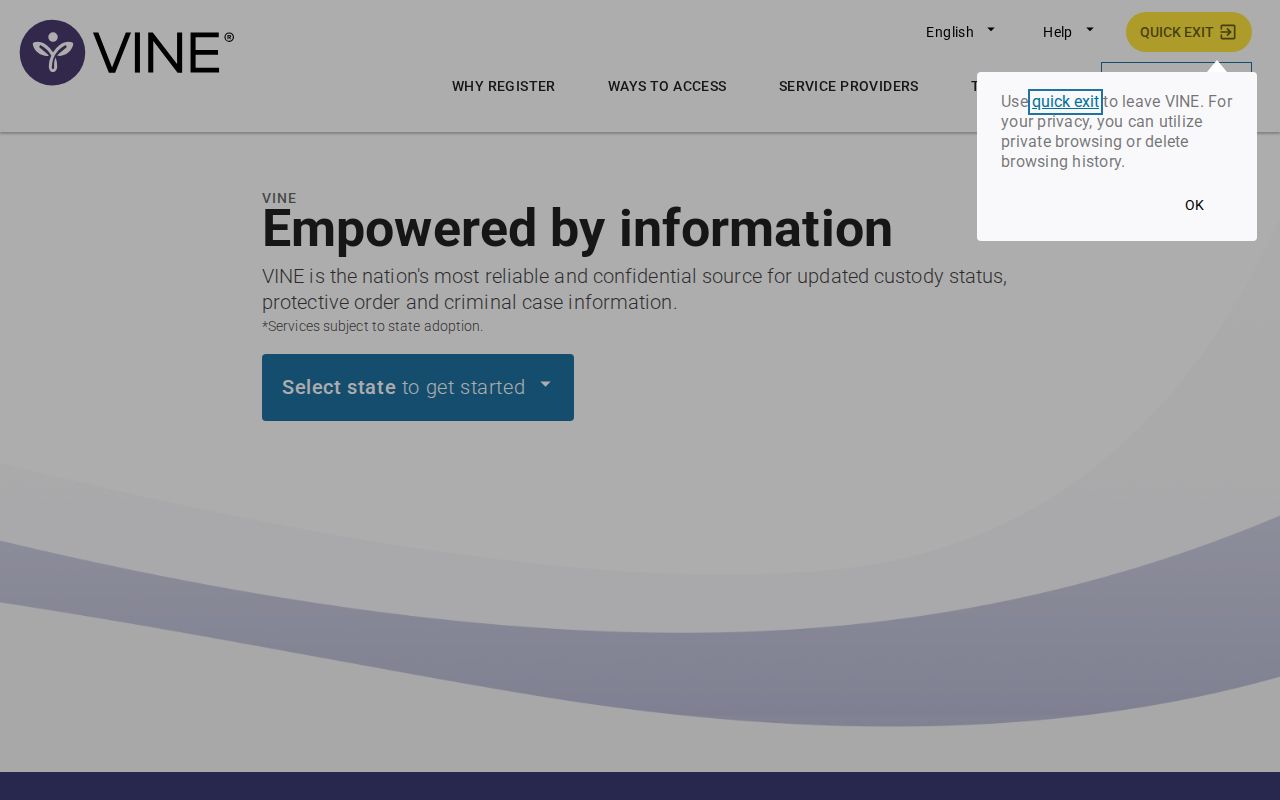
The interface is the starting point, but the identifiers and facility name are what connect the screen to the right Hancock County custody event.
Hancock County VINELink Release Fields
Read every field in the context of the particular record selected. The same person can have a county-jail episode and a state-corrections episode, and a result from one does not settle status in the other.
| Field | What it helps establish |
|---|---|
| Custody status | Whether the selected VINE record reports the person confined or not in custody. |
| Facility or agency | Which jail or corrections system supplied the event and where to confirm it. |
| Offender identifier | Which person and custody record the result represents. |
| Release date | The release event date reported for that selected record when displayed. |
| Notification option | Whether a user can register contact channels for later status changes. |
VINELink is strongest as a timely status layer. The Breckinridge custody-history and release sheet remain the better records for an exact local release time, mechanism, and receiving authority. For a state prisoner, KOOL and the KDOC Daily Releases archive provide the state record context.
Register for Hancock County Release Alerts
Registration attaches the chosen contact route to the selected offender record. It does not notify the person in custody. Check the record identity first because an alert on the wrong entry can create a false conclusion.
- Open the correct Kentucky VINELink offender result.
- Select Notify Me of Status Changes.
- Add the available phone or email contact channels needed for the notice.
- Create a four-digit PIN for automated calls.
- When a call arrives, enter the PIN to acknowledge it and stop the stated retry cycle.
More than one contact can be registered. Kentucky also provides an automated VINE line at 1-800-511-1670 around the clock. KDOC Victim Services can be reached at 502-564-5061 or 877-687-6818 for its program, while a written KDOC notification request goes to the Office of Victim Services, PO Box 2400, Frankfort, KY 40602.
Verify Every Hancock County VINELink Alert
An alert should trigger a confirmation process, not end it. First reopen the exact VINELink record and note whether the changed entry belongs to Breckinridge detention or KDOC. Call the listed facility. For a local booking, check current custody and ask Breckinridge County Detention Center for the custody-history or release entry. For a state case, compare KOOL with the date-specific KDOC Daily Releases record. A Hancock court order supplies the legal direction when the release was judicial.
Rapid court action, a credit recalculation, escape information, transfer processing, or a vendor problem can defeat advance notice or change its meaning. Kentucky describes frequent retry calls for local-jail releases and possible advance notice for state-institution releases, but those practices are not guarantees. Federal custody requires the BOP locator or the holding authority. ICE custody requires its own detainee locator and direct confirmation.
Duplicate Hancock County VINELink Records
Kentucky warns that one person may appear in more than one VINE record and advises registration on both when both are relevant. In Hancock County, that is not a remote edge case. The person may first have a Breckinridge contract-jail record tied to a Hancock booking, then receive a separate KDOC record after commitment to the state system.
Two results should not be merged merely because the names resemble each other. Match the jail booking number to the Hancock arrest or case, and match the KDOC or PID number to KOOL. Compare dates of birth, facility names, and the sequence of custody. Registering only on the local record may miss a later state event; registering only on the state record may miss the earlier local change.
Note: Each VINELink registration follows one selected record, so duplicate Kentucky entries may require separate alerts.
Build a Hancock County Release Chronology
A short chronology resolves conflicts among systems. Begin with the Hancock arrest or court date, originating agency, and case number. Connect that event to the Breckinridge booking number. Then request the custody-status history and list every movement with its date and time. If the last entry is a transfer, continue the trail through KOOL, another jail, BOP, ICE, or the named receiving agency.
If the entry instead reports bond, time served, a court order, or another community-release category, compare it with the Hancock docket and the VINE event. For a KDOC episode, add the Daily Releases entry and any supervision begin date shown in KOOL. The court-order date, physical jail-release time, VINE processing time, and supervision start date answer different questions, so small gaps do not automatically mean an error.
When a material conflict remains, contact the office that created the disputed field. Breckinridge detention controls its booking and release entry, the Hancock clerk controls the docket, KDOC controls KOOL and state release data, and VINE support addresses the notification display.
A local release record should include the booking episode, actual release date and time, disposition, and destination or receiving agency. Those fields settle questions that a simple status label cannot. A transfer out of Hardinsburg may cause one record to say the person left while another agency still holds the person. Likewise, a court order can authorize release before physical processing at the jail is complete. Keeping each event and source on its own line prevents the word "released" from being stretched beyond what the record proves.
Identity checks matter just as much as date checks. Use the date of birth, booking number, DOC or PID number, and court case number wherever the source supplies them. A name-only match can join two different people, while a single person can legitimately have several bookings. The facility label also tells which custodian can answer the next question. Breckinridge detention can explain a local custody movement, but it cannot correct a Hancock docket or a later KDOC event.
Keep a copy of the status screen and note when it was viewed if an alert appears inconsistent. Then request the existing record behind the disputed event instead of asking for a new explanation. This preserves the exact record, time, and identifier at issue and gives the responsible office a focused question to review.