
Hancock 72-Hour Release Gap
No official Hancock or Breckinridge source located during research provides a labeled 72-hour release list. Hancock does not operate a county jail. Its jailer transports arrestees to the Breckinridge County Detention Center under a county contract, and the detention center links only to a current-inmate product. That live list cannot be turned into a retrospective three-day log.
A missing name does not identify when custody ended or why. The person may have entered the community, transferred to KDOC or another jail, moved to a hospital, or left under another court-directed arrangement. The release entry must supply the actual date, time, disposition, and destination. Those fields turn a roster clue into a usable custody timeline.
Check Hancock Three-Day Releases
Define the period before contacting the custodian. Use calendar dates and, when time matters, state the beginning and ending times. A request framed as “the last 72 hours” can shift while it is being processed. An exact range remains clear. Ask for entries tied to Hancock-originating arrests or cases because the Breckinridge facility also holds people for its own jurisdiction.
- Write down the exact three-day start and end dates, including times if needed.
- Check the official current-inmate list only for present custody.
- Call the detention center at 270-756-6333 and ask who receives a release-log or release-record request.
- Request records for Hancock-originating matters within that exact period, including disposition and destination.
- Match each result to a Hancock court case, VINE record, or KDOC identifier as applicable.
For a search focused on one named person rather than all events in a date range, use the broader released-person path on the Hancock County home page. That route helps identify whether local, state, federal, or immigration custody held the person.
Hancock 72-Hour Record Fields
Because there is no public feed, the table below describes fields to request, not columns claimed to appear online. A narrow request reduces ambiguity. Include the date range, Hancock connection, and known identifiers. Ask for electronic records if the custodian can provide them, but do not assume a fee, form, or delivery time because none is published locally.
| Requested field | Use in a three-day review |
|---|---|
| Name and booking number | Separates each custodial episode and reduces mistaken identity |
| Originating county, agency, or case | Identifies which entries stem from Hancock matters |
| Booking date and time | Places the release within the correct custody episode |
| Actual release date and time | Shows whether the event falls inside the requested window |
| Release mechanism | Distinguishes bond, time served, court action, probation, or transfer |
| Destination or receiving agency | Separates community release from continued custody elsewhere |
The detention record usually supplies the physical release timestamp. A Hancock docket supplies the legal order behind bond, dismissal, probation, shock probation, or another court action. Read both when the precise chronology matters.
Hancock Weekend Release Checks
A three-day range often spans a weekend or holiday. That does not create an online weekend feed, and no local source publishes a release schedule or standard processing time. Call the detention center for current operational information. If a records office is closed, preserve the exact range and submit the request when it reopens. Do not shrink the inquiry to whichever dates happen to be visible in a live roster.
Court and jail timestamps may differ. A judge can sign an order before the contract facility finishes identity checks, paperwork, property return, and the custody handoff. VINE records when its system processed a change, which can be later still. These differences are not automatically mistakes. The releasing facility's actual timestamp is the key point for the physical end of that custody episode.
For a same-day question that cannot wait for a full three-day request, follow the focused Jail Releases: 24 Hours confirmation route.
Why Hancock Release Names Disappear
The official local web route is a present-custody check. The Breckinridge current-inmate wrapper demonstrates the limited role of that tool.
Its label does not establish any 72-hour retention or update cadence. A person who disappears must be traced through the custody-history and release fields.
- Roster absence
- A lead that the person is not shown in the current-custody view.
- Release disposition
- The recorded reason the facility ended its part of custody.
- Receiving agency
- The next custodian when the event was a transfer rather than community release.
- Release record
- The agency document that provides the actual time and mechanism of departure.
No official online retention interval is published for older entries. Expungement, sealing, restricted records, archival transfer, or vendor display limits may also affect visibility. An absent page should never be treated as proof that no booking occurred.
Hancock Cross-County Release Records
A Hancock inmate connection can describe the arrest and prosecution, not the detention building. The criminal matter may remain in Hancock District or Circuit Court while the booking and release record sits with the Breckinridge detention custodian. Searching only one county can miss half the event. The Hancock docket explains judicial authority; the Hardinsburg facility record shows the custody handoff.
The official Hancock jailer page documents that contract and transport arrangement.
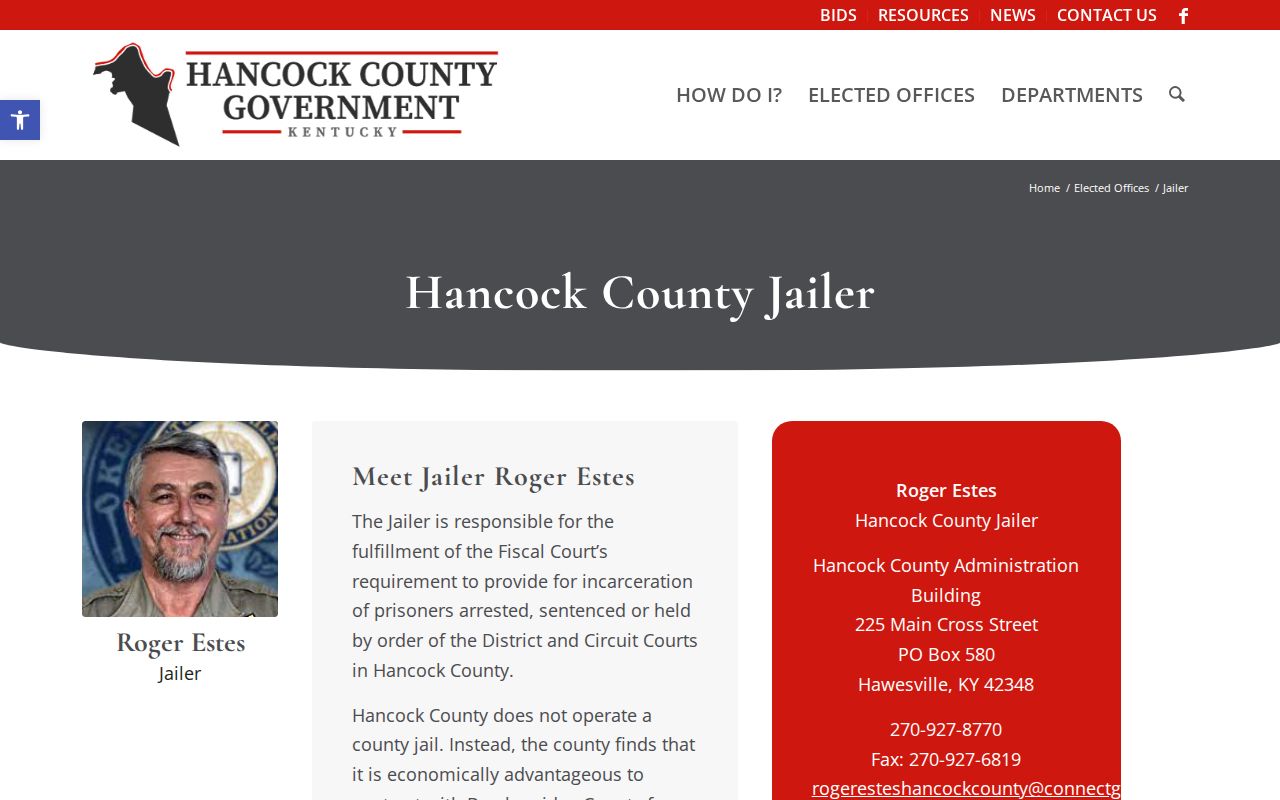
The county arrangement also explains why there is no physical Hancock jail release point or locally hosted three-day jail feed.
Hancock Three-Day Fallbacks
VINE can corroborate a specific person's status and release date in a reporting local-jail or KDOC record. It is not a browseable list of everyone released during a weekend. One person may have both a jail record and a state record, so compare identifiers and check each relevant entry. Confirm any notice with the detention center, KDOC, or the court that ordered release.
If the local record says transfer to KDOC, search KOOL using the DOC or PID number when available. KOOL can show current corrections status and supervision, but its future date fields are not actual-release proof. Search the KDOC Daily Releases archive by each date in the range and match the DOC number, release type, and “Released From” field. That archive covers the state corrections population, not all short stays at the contract jail.
Federal or immigration custody requires a separate trail. Use the BOP locator for a federal prisoner, the holding facility and federal order for a USMS detainee, or the ICE locator while a released record remains available. A county roster cannot rule out any of those systems.
Verify Hancock Release Results
A durable result joins identity, dates, and disposition. Match the full name with date of birth, booking number, DOC or PID number, and court case number wherever those fields exist. Then arrange the events in order: Hancock arrest or court action, Breckinridge booking, each custody movement, and the final release or transfer. Similar names and repeat bookings make identifiers essential.
- Use the jail timestamp for the end of that facility's custody.
- Use the destination field to separate release from transfer.
- Use the Hancock order to explain judicial authority.
- Use VINE as corroboration, not the sole proof.
- Use Daily Releases only for a KDOC population event.
If official records conflict, preserve the URLs, access dates, identifiers, and exact disputed fields. Ask the office that created the field to explain or correct it. The contract jail controls its release entry, the Hancock clerk controls its docket, and KDOC controls its corrections records.
Scope Hancock Release Requests
A useful three-day request identifies both place and origin. Ask the Breckinridge detention custodian for releases during the fixed range that arose from Hancock arrests or cases. Include the person's name only when the inquiry is person-specific. For a log request, ask for the existing fields rather than requiring staff to create a new report. The likely useful fields are booking number, admission time, actual release time, disposition, originating agency or case, and receiving authority. If no record exists in that form, ask how the same information is kept.
Send court-record questions to the Hancock clerk, not the contract jail. The docket may show the order date, bond action, dismissal, sentence, probation, shock probation, or later revocation. Yet a court order does not state the exact moment facility processing ended. Likewise, send jail-record questions to the detention custodian instead of asking the court to reconstruct a custody timestamp. Keeping each request tied to the record creator produces a clearer three-day chronology.
No official local source publishes a special release-log form, copy charge, office schedule, turnaround promise, or record-retention period. Those details should come from the current custodian. If a record is withheld or unavailable, ask for the reason and any applicable route to an archived file.
Public Record Search
Sponsored Results